
Assessing Your Culture. Four Simple Steps To Create YOUR Perfect Evaluation Tool
Culture is difficult to measure. Here is a blueprint to create your own taylor-made assessment.


“Culture eats strategy for breakfast.” Sure, we’ve all heard this quote, often (though incorrectly) attributed to Peter Drucker. But the hard truth is that management struggles to weave culture into the decision-making process. And not surprisingly. Culture is difficult to measure and the measures we have often don’t work. They are simply too generic. But few executives are comfortable making decisions which are not data and fact based.
Working for three years with a large asset management company (10,000 employees, $750 billion under management), we developed a blueprint that can easily be replicated elsewhere. It’s a four-step process combining an adaptable survey and workshops.
Step 1: Define “what good looks like”
We are assuming that you have a set of core values (if you don’t, better get started!). In the firm that we worked with these values were Bold, Curious and Compassionate.
To build your own assessment tool, you start with these values. Careful, though! The interpretation of what they mean may vary by country. Our company initially asked an external consulting firm to create a GLOBAL framework for subsidiaries to support their annual employee performance review. That turned out to be a misstep, the executives wanted a more organic tool that worked on the local level.
The Japanese subsidiary did not buy in. Turns out that specific wordings used to define your values can be highly context sensitive. Whilst that seems obvious, it is easy to overlook when optimising at a global level. For example, the value “Bold” didn’t land as desired in Japan. Terms like “proactive” and “urgency” worked a lot better.
It did not take us long to realise that we will only be able to create a solid assessment tool for culture by consulting the different stakeholders in each subsidiary. Based on this process we were able to break down the values into smaller, more translatable constructs. Plus, we were able to define what good practice would actually look like. Here is the one for Ireland, showing that even in English-speaking countries a cultural translation is necessary.
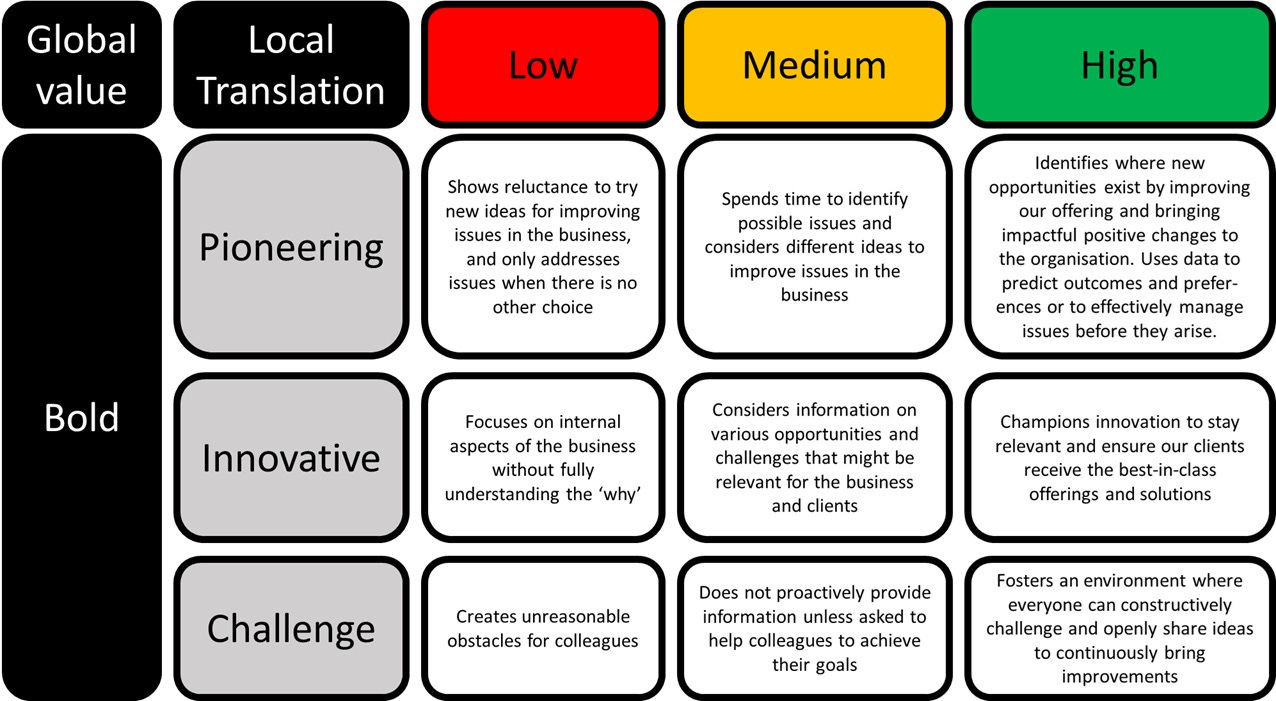
Figure 1: defining what good looks like
It’s not rocket science. As soon as we started to engage with representatives, we understood how we needed to translate global values in a way that made sense locally. The main challenge was the time it took to get this right. But not doing this sets you up for failure before you’ve even started.
Step 2: The survey
Once you have developed an understanding of what good cultural practices look like in regards to your values, you can then design the survey items. Here is what ours were for “Bold” for Ireland (we obviously did the same for the other values):

Figure 2: the survey statements
We also added three open-ended questions to the survey. Fortunately, in the age of AI dealing with a large amount of text has become a lot easier. We received 3,000 comments that turned out to add important colour to our analysis.
Before we sent out the survey, we made sure that business unit managers were on board. This made it easier to have difficult discussions when the results required them to make changes.
Additionally, we printed posters with QR codes for the survey and placed them in communal areas. Cafeteria and around the lifts were high traffic areas we leveraged. It helped us to achieve a 70% response rate. This in turn increased the motivation to take the results seriously.
Step 3: Workshop and evaluate the results to create momentum
After the survey is done, the temptation is to simply share headline results. To turn data into action, we wanted to take one extra step though. We needed to build momentum. This was done through group assessment workshops.
The workshops were focussed on collectively assigning a maturity rating for each value and translated behaviour in each location. Armed with a solid understanding of the survey results we broke out into groups to discuss the output from the survey. Where did we live our values, where did we have gaps? And how does it affect our business? We also brought in some data from customer surveys, complaints, and HR data to complement what we knew from the survey.
Step 4: Identify the gaps and what needs to be done
Local leadership identified and discussed priorities with distinct action plans for each location. The combination of data linked to the organisational values and a workshop bringing the decision makers to the table to have an open cross-functional discussion turned culture from a fuzzy concept into something that was measurable and manageable.
Following these four steps, executives can measure the strength of their organisational culture with the aim of strengthening it to improve performance.
Key Takeaways for Managers
Localise your values - global words rarely land the same everywhere.
Define behaviours, not slogans - clarity drives accountability.
Use mixed methods - surveys alone won’t reveal the real culture.
Create momentum through workshops - culture shifts when leaders talk openly about gaps.
Own the interventions - senior leaders must track and drive progress.
Relationships matter - culture change is ultimately a social process.
Dr. Peace Ani is the founder of Occasio Consulting, a UK based boutique Management Consulting and Advisory, with a distinctive focus on Culture, Conduct and behavioural change alongside traditional Governance effectiveness advisory work; connect with her on LinkedIn.
Professor David G. Allen is Luther Henderson University Chair in Management and Leadership at the Neeley School of Business at TCU. His research, teaching, and consulting focuses on people at work with a particular interest in the flow of human capital into and out of organizations. Connect with him on LinkedIn.
 | A guest post by
|
 | A guest post by
|
Excellent article Peace. A clear roadmap to help understand your culture, how it shapes your current architecture and how to reshape it to support your objectives. Very enjoyable and useful.
Like the idea where the organisation moved away from slogans.
I was reading something recently about how much organisations rely on them. They sound right, but don’t always translate into something people can actually live out day to day.
It made me think of Viktor Frankl and his ideas that meaning has to be discovered and lived, not just defined. Culture feels similar. You can set the values, but people have to recognise them in themselves and actually show up in that way.
And it also connects, in a way, to Drucker’s idea of the organisation as a learning system. What you’ve described here feels like a more grounded version of that… where meaning is actually worked through in context rather than assumed.
Would be really interesting to know what actually surfaced from this in practice, especially where things didn’t quite align as expected.